
The Biggest “Breakup” in AI Isn’t About Models. It’s About Chips.
Many big AI systems run on Nvidia GPUs (graphics chips that are great at AI math).
So when people see a headline like “Meta Google chip deal Nvidia,” it spreads fast.
But here’s the key point: Meta and Google have not publicly announced a huge chip supply deal. We have not seen a press release, SEC filing, or clear statement from either company saying Google will replace Nvidia for Meta’s AI work.
What is real is still a big story. Meta wants less risk. That means using more than one source for AI compute (the chips + data centers used to train and run AI). One possible option is renting Google TPU (Tensor Processing Unit) machines through Google Cloud.
Why Does Meta Need an Alternative to Nvidia in the First Place?
Nvidia makes GPUs (graphics processing units). These chips are a top choice for AI training.
Many teams use Nvidia’s H100 and H200 data-center GPUs, like the ones shown on Nvidia’s H100 page and Nvidia’s H200 page.
When lots of companies want the same chips, waits can get longer and prices can stay high. That makes buyers nervous.
There is also policy risk. The U.S. government has tightened rules on advanced AI chips in recent years, including updates explained by the U.S. Department of Commerce. Rules like this can affect where advanced chips can be shipped.
Meta is also working on its own chips. One example is MTIA (Meta Training and Inference Accelerator). Meta introduced MTIA on the Meta Engineering blog.
What Is Google Actually Selling Meta?
Google has TPUs (Tensor Processing Units). These are Google-made AI chips.
TPUs are mostly offered as a cloud service. That means you rent them inside Google’s data centers, instead of buying a card and installing it yourself. Google explains this on the Google Cloud TPU page.
Google also keeps updating TPUs. For example, Google announced “Trillium” (a newer TPU generation) in a Google Cloud blog post.
So what could “Google supplying chips” mean in real life?
Most of the time, it means a company rents TPU compute inside Google Cloud. It is like renting a server. You pay for what you use.
Could Meta do that? In general, yes. Google Cloud sells TPU access to customers.
But there is no public confirmation that Meta has signed a multibillion-dollar TPU deal. There is also no public confirmation that Meta is moving a major share of AI training away from Nvidia.
Still, the idea matters. If big buyers have more choices (Nvidia GPUs, their own chips, or cloud TPUs), Nvidia has less power to set prices.
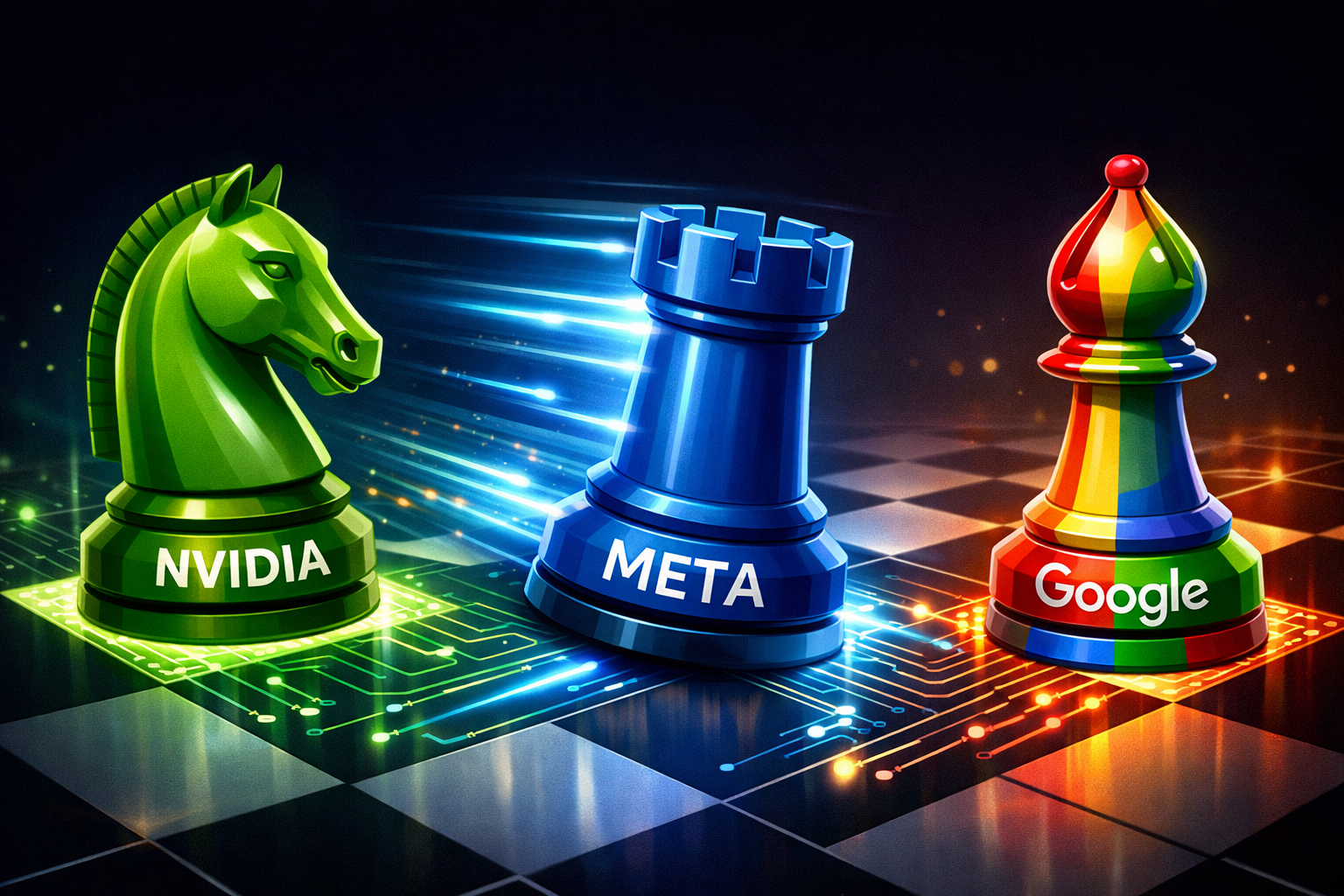
The Strategic Chess Move Here Is Obvious (Once You See It)
This part is about leverage (having options so you can negotiate).
When one company supplies a key part, buyers want backups. In AI, the key part is compute (chips + data centers).
That is why many big tech firms are building their own AI chips:
- Amazon has Trainium, listed on AWS.
- Microsoft announced Maia (its AI chip) in a post on the Microsoft Blog.
- Meta has MTIA, described by Meta Engineering.
These chips do not replace Nvidia overnight. Nvidia is still a default choice for many teams.
A big reason is CUDA (Nvidia’s software tools for running code on GPUs), explained on Nvidia’s CUDA site. Lots of AI code is built around it.
But the long-term trend is clear: big buyers want options.
What Does This Mean for AI Development Going Forward?
Chips help decide how fast AI improves.
If companies can get more compute for less money, they can train more models and run them more often.
If the market gets more choices (GPUs, TPUs, and custom chips), a few things can happen over time:
- More capacity (more training runs and more tests)
- Better prices (more competition can help)
- Less risk (fewer supply surprises if one vendor is delayed)
This is not instant. Moving AI systems between chip types is hard.
Software often needs changes and lots of testing to run well on a different chip.

The Part Nobody’s Talking About: Google Could Become an Infrastructure Supplier to a Competitor
Google and Meta compete in ads and AI (the actually benefit each other in this realm, but that’s a discussion for another post).
But cloud works like this. A cloud provider sells compute to many companies, even rivals.
We already see this with OpenAI and Microsoft. OpenAI says Azure is its main cloud partner in a post on OpenAI’s site.
So the real takeaway is simpler than the viral headline.
There is no confirmed “Meta is breaking up with Nvidia” deal. But there is a real shift toward more chip choices.
Meta’s MTIA work and the rise of cloud TPUs are part of that shift. Nvidia is still a top player. But the chip race is getting louder.
Sources
- Meta Engineering, MTIA announcement and goals
- Google Cloud, Cloud TPU product page and how TPU access is provided
- Google Cloud Blog, Trillium (6th gen TPU) announcement
- AWS, Trainium overview
- Microsoft Blog, Maia (custom AI chip) announcement
- U.S. Department of Commerce, Export control updates for advanced computing
- OpenAI, OpenAI and Microsoft/Azure partnership details
- Nvidia, H100 overview
- Nvidia, H200 overview
- Nvidia, CUDA platform overview
TL;DR
- There is no public proof of a massive “Meta Google chip deal Nvidia” swap where Google replaces Nvidia for Meta.
- Meta still has strong reasons to avoid relying on only one chip supplier.
- Google’s TPUs are mainly rented through Google Cloud, not sold like normal GPU cards.
- Big tech is building more custom AI chips (Meta MTIA, Amazon Trainium, Microsoft Maia) to get more options.
- Nvidia still leads in many AI setups, mostly because of its GPU ecosystem and CUDA software.
FAQ
Did Meta officially replace Nvidia with Google TPUs?
No. Meta and Google have not publicly confirmed any deal where Google replaces Nvidia for most of Meta’s AI work.
What does “Google supplies chips” usually mean?
It usually means renting TPU machines inside Google Cloud. You pay to use Google’s hardware in Google’s data centers.
Why doesn’t Meta want to depend only on Nvidia?
Because one supplier can mean more risk. If supply is tight or prices rise, Meta has fewer backup plans.
What is MTIA?
MTIA is Meta’s in-house AI chip project. Meta says it is meant to help with training and inference (running AI) over time.
Will TPUs “kill” Nvidia?
Not soon. Nvidia is still a top choice, and many tools are built for Nvidia GPUs and CUDA. But more chip options can increase competition.