
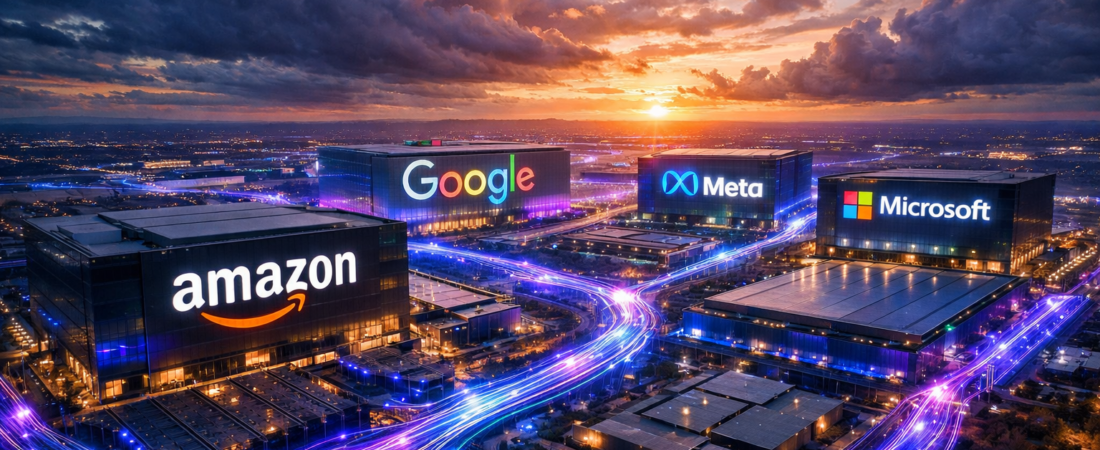
If you thought Big Tech was already spending big on AI, buckle up, because what’s coming in 2026 makes previous investments look like pocket change. Amazon, Alphabet (Google’s parent company), Meta, and Microsoft are collectively planning to drop roughly $650 billion on AI infrastructure this year. Yes, you read that right: $650 billion with a ‘B’.
To put this in perspective, this represents a staggering 60% increase from last year’s spending and ranks as one of the largest corporate spending booms in United States history. We’re not just talking about incremental growth here, this is a fundamental reshaping of how tech giants are allocating their resources.
Breaking Down the Numbers
When we talk about $650 billion in capital expenditure (capex), what exactly are we referring to? This isn’t money being spent on fancy office furniture or executive bonuses. This is cold, hard cash going directly into:
- Data centers: Massive facilities filled with specialized hardware to train and run AI models
- Advanced chips: Particularly GPUs (graphics processing units) and custom AI accelerators that can handle the intense computational demands of machine learning
- Networking infrastructure: High-speed connections that can move vast amounts of data between systems
- Energy systems: Power grids and cooling systems to keep these energy-hungry operations running
- Research facilities: Labs and teams dedicated to pushing AI capabilities forward
Each of these four tech giants has their own specific AI ambitions driving these investments. Microsoft is deeply integrated with OpenAI and betting heavily on AI-powered services across its product suite. Amazon Web Services (AWS) is racing to maintain its cloud computing dominance in an AI-first world. Meta is investing in AI to power everything from content recommendations to its metaverse ambitions. And Alphabet continues pushing the boundaries with its DeepMind division and AI integration across Google’s entire ecosystem.
Why Now? The AI Arms Race Explained
You might be wondering: why such a dramatic increase this year specifically? The answer lies in what’s happening right now in the AI landscape.
First, we’ve entered what many are calling the “infrastructure phase” of the AI revolution. The initial proof-of-concept stage, where companies demonstrated that AI could be useful, is over. Now it’s about scaling these capabilities to billions of users while maintaining performance and reliability.
Second, the competition is absolutely fierce. No major tech company wants to be left behind in what many executives view as the defining technology of the next decade (or longer). Being second-best in AI could mean losing market position across multiple business lines, from cloud services to advertising to consumer products.
Third, the technical requirements keep growing. As AI models become more sophisticated, think GPT-4 versus GPT-3, or the latest image generation models versus their predecessors, they require exponentially more computing power to train and operate. This creates a constant pressure to invest in more and better infrastructure.
What This Means for the Rest of Us
This level of investment doesn’t happen in a vacuum. The ripple effects will be felt across the economy and society:
For consumers: Expect AI features to become standard across virtually every digital product you use. From smarter virtual assistants to more personalized content recommendations to AI-powered creative tools, these investments will translate into tangible capabilities in apps and services you use daily.
For businesses: Small and medium-sized companies will benefit from increasingly powerful and affordable AI tools provided by these tech giants through their cloud services. What once required a specialized AI team and millions in infrastructure will become accessible via API calls costing pennies.
For workers: The job market will continue its AI-driven transformation. While some roles will be displaced, new categories of jobs, from AI trainers to prompt engineers to AI ethics specialists, are emerging rapidly. The key is staying adaptable and learning to work alongside AI tools rather than competing with them.
For investors: This spending level signals that Big Tech sees AI as a long-term structural shift, not a passing trend. However, it also means these companies are prioritizing growth and market position over short-term profitability, which could affect stock performance in various ways.
The Concerns and Criticisms
Not everyone is celebrating this spending spree. Critics have raised several important concerns:
Market concentration: When four companies can collectively spend $650 billion, it raises questions about market power and whether smaller competitors can ever catch up. This level of investment creates massive barriers to entry in the AI space.
Environmental impact: AI data centers are energy-intensive operations. While tech companies are increasingly using renewable energy, the sheer scale of operations means the carbon footprint remains substantial. Some environmental groups are questioning whether society is adequately weighing the environmental costs against the benefits.
Resource allocation: Some economists wonder if this represents the most efficient allocation of capital in the economy. Is $650 billion in AI infrastructure really where society needs investment most, or are market dynamics pushing companies toward an inefficient arms race?
Regulatory uncertainty: Governments worldwide are still figuring out how to regulate AI. Massive infrastructure investments made today could face regulatory challenges tomorrow, potentially stranding capital or requiring expensive modifications.
Looking Ahead
What’s particularly striking about this $650 billion figure is that it probably won’t be the peak. Most industry analysts expect AI infrastructure spending to continue growing in 2027 and beyond, at least until the market reaches some form of maturity, which could be years away.
We’re witnessing a historical moment in technology investment that rivals the dot-com boom, the mobile revolution, and the rise of cloud computing. The difference is that this time, the companies doing the investing are already among the largest and most powerful corporations in human history.
The outcome of this spending boom will shape the digital landscape for years to come. It will determine which companies lead the AI era, what capabilities become possible, and how AI integrates into everyday life. For anyone working in tech, investing in tech stocks, or simply living in our increasingly digital world, understanding this investment wave isn’t optional, it’s essential context for understanding where technology is headed.
One thing is certain: at $650 billion, Big Tech is putting its money where its mouth is on AI. Now we’ll see if the returns justify the investment.
TL;DR
- Amazon, Alphabet, Meta, and Microsoft plan to spend approximately $650 billion combined on AI infrastructure in 2026
- This represents a 60% increase from 2025 spending levels and is one of the largest corporate spending booms in US history
- The investment focuses on data centers, advanced AI chips, networking infrastructure, energy systems, and research facilities
- This spending spree reflects an intense AI arms race where no major tech company wants to fall behind in what’s seen as the defining technology of the decade
- The investments will impact consumers through enhanced AI features, businesses through more accessible AI tools, and workers through continued job market transformation
FAQ
Why are tech companies spending so much on AI infrastructure?
Tech companies view AI as the defining technology of the next decade and are racing to build the infrastructure needed to train advanced AI models and deploy them at scale. The competition is fierce, and being left behind could mean losing market position across multiple business lines including cloud services, advertising, and consumer products.
What exactly is this $650 billion being spent on?
The spending covers data centers filled with specialized hardware, advanced AI chips (particularly GPUs and custom accelerators), high-speed networking infrastructure, energy and cooling systems to power these facilities, and research labs dedicated to advancing AI capabilities.
Which companies are making these massive AI investments?
The four largest contributors are Amazon, Alphabet (Google’s parent company), Meta (Facebook’s parent company), and Microsoft. Each has specific AI ambitions driving their investments, from cloud computing dominance to AI-powered consumer services.
How will this affect everyday consumers?
Consumers can expect AI features to become standard across virtually every digital product, including smarter virtual assistants, more personalized content recommendations, AI-powered creative tools, and enhanced capabilities in apps and services used daily.
Are there concerns about this level of AI spending?
Yes, critics have raised concerns about market concentration and barriers to entry for smaller competitors, environmental impact from energy-intensive data centers, questions about efficient resource allocation, and regulatory uncertainty that could affect these investments.