
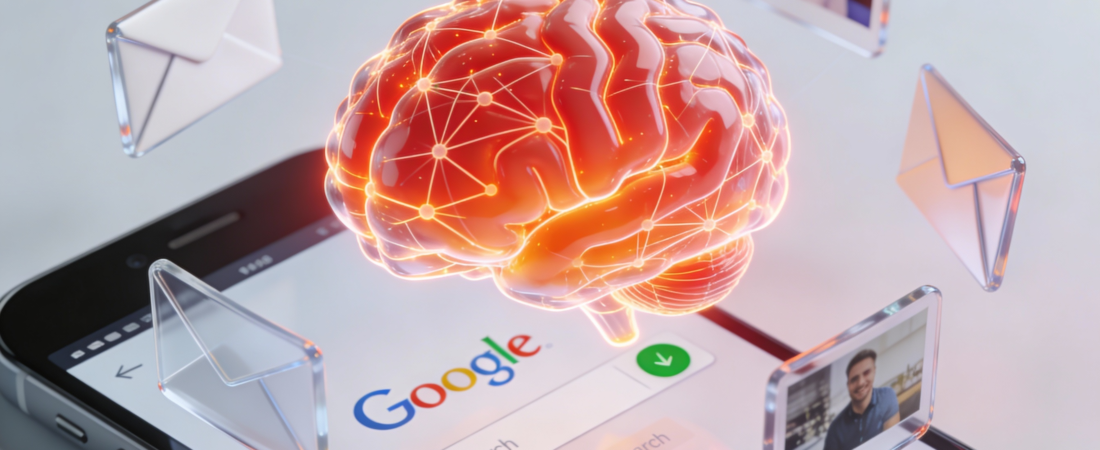
Google just made search a whole lot more personal, and honestly, I’m not sure whether to be excited or a little creeped out. Let me explain what’s happening.
The search giant announced they’re expanding something called “Personal Intelligence” into their AI Mode feature. What does that actually mean? In simple terms, Google Search can now dig into your private Gmail and Google Photos to give you search results tailored specifically to you and your life.
What Exactly Is AI Mode Doing With Your Data?
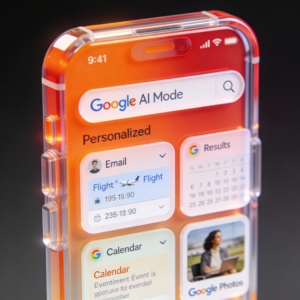
Think about how you use Google Search today. You type in “what’s my flight status” or “where did I save that recipe,” and Google gives you generic results from across the web. That’s helpful, but it’s not really your answer.
With this new Personal Intelligence update, AI Mode can actually look through your Gmail for flight confirmations, hotel bookings, package tracking, or any other information sitting in your inbox. It can scan your Google Photos to find specific images based on when and where they were taken, who’s in them, or what you were doing.
Here’s a real-world example: instead of searching through dozens of emails to find your dentist appointment confirmation, you could just ask “when’s my next dentist appointment?” and AI Mode would pull it straight from your Gmail. Or ask “show me photos from Maggie’s birthday last year,” and it’ll find them in your Photos library without you having to scroll endlessly.
For someone like me who lives in Gmail and has thousands of photos scattered across Google Photos, this could be a genuine time-saver. As a marketer juggling campaigns, client emails, and personal stuff, having an AI assistant that actually knows my context sounds incredibly useful (Google’s predecessor Personal Context has DEFINITELY been helpful in my business life).
The Privacy Question We Need to Talk About

Now here’s where things get interesting, and where I imagine some of you might be pumping the brakes a bit. Google is essentially asking for permission to let their AI read through your most private digital spaces: your emails and your photos.
I get it. That feels invasive. We’re already used to Google “knowing” a lot about us through search history and location data, but this feels like a different level of access. These are our personal conversations, medical information, financial records, family photos, everything.
Google says this data stays private and is only used to personalize your results. They’re not training AI models on your emails or selling your information. The processing happens within your Google account ecosystem. But still, you’re trusting Google to handle some of your most sensitive information responsibly.
For me, the question comes down to this: is the convenience worth the trade-off? As someone who’s been building AI tools and experimenting with different platforms, I’ve learned that these systems are only as useful as the context they have. The more they know, the better they can help. But that means we’re constantly making these privacy calculations.
What This Means for Everyday Users

If you decide to opt in (and yes, this will be opt-in, not automatic), here’s what you can realistically expect:
The Good Stuff: You’ll save time on information retrieval. No more digging through email folders or photo albums. Ask natural language questions and get personalized answers instantly. For busy parents, professionals, or anyone drowning in digital clutter, this could be legitimately helpful.
The Learning Curve: Like any AI tool, there’ll be a period where you figure out what works and what doesn’t. You’ll need to learn how to phrase questions effectively and understand what information AI Mode can and can’t access.
The Privacy Trade: You’re giving Google’s AI deeper access to your personal life. That’s not inherently bad, but it’s something to be aware of and comfortable with.
As someone who’s not super technical but loves experimenting with AI, I see this as Google trying to compete with tools like ChatGPT and Claude that already offer personalized assistance. The difference is Google has access to a treasure trove of your existing data, which could make their AI significantly more useful right out of the gate.
My take? I’ll likely try it. As I said, personal context through their enterprise plan has been helpful for me, so I’m sure it would be on the consumer side w/ the additional functionality. But I’m also going into this with my eyes open, knowing exactly what I’m trading for that convenience & knowing the consumer side isn’t as “locked down” as the enterprise side when it comes to sharing info with Google. If it feels too intrusive or doesn’t deliver real value, I can always turn it off.
This is the direction AI is heading: more personal, more contextual, more integrated into our daily digital lives. Whether that excites you or concerns you probably depends on how much you trust the companies building these tools and how much value you place on convenience versus privacy.
What do you think? Would you let Google’s AI read your emails and photos to give you better search results? Or is that a bridge too far?
TL;DR
- Google’s AI Mode can now access your private Gmail and Google Photos to deliver hyper-personalized search results based on your actual life and data.
- The feature is opt-in and promises to keep your data private within your Google account ecosystem, not using it for broader AI training.
- Practical benefits include instant answers to personal questions like appointment times, travel details, or finding specific photos without manual searching.
- The privacy trade-off: you’re giving Google’s AI deeper access to sensitive personal information in exchange for convenience and time savings.
- This represents AI’s evolution toward more contextual, personalized assistance, competing with tools like ChatGPT but with access to your existing Google data.
FAQ
Is Google AI Mode reading my emails without permission?
No. Personal Intelligence in AI Mode is an opt-in feature. Google won’t access your Gmail or Photos data for personalized search unless you explicitly enable this feature. You stay in control of whether AI Mode can access your private information.
Will Google use my emails and photos to train their AI models?
According to Google, your personal data accessed through AI Mode stays private and is only used to personalize your search results. They’ve stated this information won’t be used to train broader AI models or be shared with advertisers. The processing happens within your Google account ecosystem.
What kind of information can AI Mode find in my Gmail?
AI Mode can search through your Gmail for things like flight confirmations, hotel bookings, package tracking, appointment reminders, receipts, and any other information in your emails. It can answer questions like “when’s my next doctor appointment?” or “where’s my package?” by pulling relevant details from your inbox.
Can I turn off AI Mode’s access to my personal data?
Yes. Since this is an opt-in feature, you can disable AI Mode’s access to your Gmail and Photos at any time through your Google account settings. If you decide the privacy trade-off isn’t worth it or you’re not finding it useful, you can turn it off and return to standard Google Search.
How is this different from regular Google Search?
Regular Google Search gives you results from across the public web based on your query. AI Mode with Personal Intelligence looks at your private data (Gmail, Photos) to give you personalized answers specific to your life. Instead of generic results, you get answers pulled from your own emails, calendar, and photo library.