
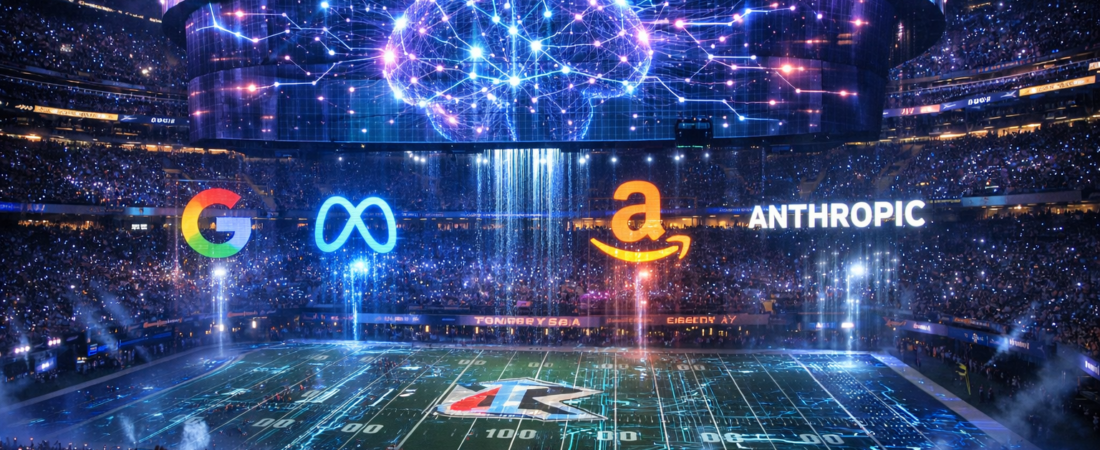
The Super Bowl has always been America’s biggest advertising stage, a cultural phenomenon where companies pay millions for 30 seconds of airtime to reach over 100 million viewers. But Super Bowl LX is shaping up to be different. This year, the ads aren’t just about beer, cars, and chips. They’re about artificial intelligence.
In a striking shift that signals AI’s arrival in mainstream consciousness, major tech companies including Anthropic, Google, Amazon, and Meta are centering their Super Bowl advertising around AI capabilities and features. Combined with the prevalence of GLP-1 weight-loss drug ads and celebrity-studded productions, this year’s Super Bowl commercial lineup reads like a snapshot of what corporate America thinks matters most right now.
Why the Super Bowl Matters for Tech Advertising
First, let’s talk about what it means when tech companies decide to advertise during the Super Bowl. These aren’t cheap decisions, a 30-second spot during the big game now costs upwards of $7 million, not including production costs (which can easily run into the millions for elaborate celebrity-filled productions).
For most of tech history, Silicon Valley companies avoided traditional mass-market advertising, especially something as expensive as the Super Bowl. The thinking was that tech products spread through word-of-mouth, app stores, and digital marketing, not through broadcast television commercials watched by your grandmother.
But that calculation has changed. When you see Anthropic (the AI company behind Claude), Google, Amazon, and Meta all buying Super Bowl airtime to talk about AI, it signals a fundamental shift: AI is no longer just for early adopters and tech enthusiasts. It’s ready for everyone.
Anthropic’s Big Moment
Perhaps the most striking presence is Anthropic, a company that many average Americans have never heard of. Founded by former OpenAI executives, Anthropic created Claude, an AI assistant that competes with ChatGPT. The company has been more focused on AI safety and responsible development than on flashy marketing.
Until now.
Anthropic’s decision to advertise during the Super Bowl represents a coming-out party. The company is signaling that it’s ready to compete not just for enterprise contracts and developer mindshare, but for regular consumers’ attention and usage. This is especially significant given that Anthropic has raised billions in funding (including major investments from Google and Amazon) and needs to demonstrate that it can achieve mass-market adoption, not just impress AI researchers.
The Super Bowl ad gives Anthropic something money can’t easily buy otherwise: instant brand recognition among hundreds of millions of people who might never read tech news or follow AI developments.
The Big Tech AI Showcase
Google, Amazon, and Meta taking Super Bowl slots for AI messaging is equally significant, though for different reasons.
Google has been in an interesting position with AI. Despite pioneering much of the research that enabled the current AI boom (the “transformer” architecture that powers ChatGPT was invented by Google researchers), the company initially seemed caught flat-footed by ChatGPT’s viral success. Google’s Super Bowl presence for AI is about reasserting leadership and reminding consumers that Google has powerful AI capabilities integrated across its products, from Search to Gmail to Photos.
Amazon is likely focusing its AI messaging on two fronts: Alexa’s AI enhancements and AWS’s AI services for businesses. For consumers, the message is that Alexa is getting dramatically smarter and more capable. For the business decision-makers watching the game, it’s a reminder that Amazon Web Services is a major player in providing AI infrastructure and tools.
Meta has a particularly interesting AI story to tell. The company has been investing heavily in AI for years, but much of that work happens behind the scenes in content recommendation algorithms and ad targeting. Meta’s Super Bowl messaging is probably about making AI tangible, showing how AI features in Instagram, Facebook, and WhatsApp make these platforms more useful and entertaining.
The Celebrity Factor
Here’s what’s really interesting about this year’s AI-focused Super Bowl ads: they’re not dry, technical demonstrations. They’re celebrity-studded productions designed to entertain and engage, not just inform.
This approach reflects a crucial insight: to make AI mainstream, you can’t just explain what it does, you need to make it feel accessible, fun, and non-threatening. Celebrities serve as trusted intermediaries, familiar faces that can introduce unfamiliar technology. If a beloved actor or athlete is using AI and seems comfortable with it, that sends a powerful signal to viewers that maybe they should give it a try too.
This celebrity-driven approach also helps address lingering concerns about AI. When technology feels abstract or threatening, seeing real people (or at least, famous people) interact with it naturally can reduce anxiety and increase openness.
What This Tells Us About AI’s Current Moment
The concentration of AI advertising in Super Bowl LX reveals several important truths about where we are in AI’s development and adoption:
The technology is mature enough for regular people: Companies wouldn’t spend $7+ million per 30-second spot if they didn’t believe the products were ready for mainstream use. These ads signal that AI tools have crossed the threshold from “interesting but flaky” to “reliable enough to recommend to your parents.”
The market is heating up: Multiple companies advertising AI during the same Super Bowl suggests intense competition. Each company wants to be the AI brand that sticks in consumers’ minds. With hundreds of millions in R&D invested, winning consumer mindshare is crucial.
Differentiation is getting harder: When everyone’s advertising AI, the challenge becomes: how do you stand out? This is why we’re seeing heavy celebrity involvement and creative storytelling rather than technical specifications. The underlying technology may be similar, but the branding and emotional connection matter more than ever.
B2C is the new frontier: For the past couple years, much of the AI excitement has been in business-to-business applications and developer tools. The Super Bowl advertising signals that consumer applications are now the primary battleground.
The GLP-1 Connection
It’s worth noting that AI ads aren’t the only major tech-adjacent trend in this year’s Super Bowl advertising. GLP-1 weight-loss drugs (like Ozempic and Wegovy) are also getting significant airtime, often from telehealth companies that make these drugs more accessible.
The connection? Both AI and GLP-1 drugs represent transformative technologies that have moved from specialized, early-adopter markets into mainstream consciousness. Both have generated enormous hype and controversy. And both are now at the stage where companies believe mass-market advertising makes sense.
The parallel isn’t perfect, but it’s notable that two of the dominant advertising themes in Super Bowl LX are technologies that many Americans first heard about within the last two years and that promise to significantly change daily life.
What Comes Next
Super Bowl advertising is often a lagging indicator, companies advertise things when they’re ready for mainstream adoption, not when they’re cutting-edge. In that sense, the AI-heavy Super Bowl LX confirms what many in tech have been saying: AI’s “iPhone moment” has arrived.
Just as the smartphone went from a niche business tool to an essential part of daily life for billions, AI is making that same transition now. The Super Bowl ads are both a reflection of this shift and an accelerant of it.
Over the next year, expect to see AI capabilities become standard features across virtually every digital product you use. The companies advertising during the Super Bowl aren’t just promoting what AI can do today, they’re priming the pump for widespread adoption and normalizing the idea that AI assistants, AI-generated content, and AI-powered features are just part of how technology works now.
For anyone who’s been following AI development closely, these Super Bowl ads might feel like old news. But for the millions of Americans who don’t read tech blogs or follow AI researchers on social media, Super Bowl LX might be the moment when AI goes from something they’ve vaguely heard about to something they understand is personally relevant.
And that’s exactly what these companies are banking on, and willing to spend millions to achieve.
TL;DR
- Super Bowl LX features heavy AI advertising from major tech companies including Anthropic, Google, Amazon, and Meta
- Anthropic's Super Bowl presence marks a significant push for mainstream consumer adoption, despite being relatively unknown to general audiences
- The ads feature celebrity talent and entertainment-focused approaches rather than dry technical demonstrations, making AI feel accessible and non-threatening
- This advertising blitz signals that AI has reached mainstream maturity and companies believe consumers are ready to adopt these technologies
- The concentration of AI ads reveals intense competition for consumer mindshare as AI moves from business applications to consumer-facing products
FAQ
Why are tech companies advertising AI during the Super Bowl?
Tech companies are advertising during the Super Bowl because they believe AI technology is now mature enough for mainstream consumer adoption. The Super Bowl's massive audience (over 100 million viewers) provides an opportunity to build brand recognition and normalize AI for regular Americans who may not follow tech news closely.
Who is Anthropic and why is their Super Bowl ad significant?
Anthropic is an AI company founded by former OpenAI executives that created Claude, an AI assistant competing with ChatGPT. Their Super Bowl ad is significant because it represents a push for mainstream consumer recognition rather than just enterprise and developer adoption, signaling the company's readiness to compete in the mass market.
Why are so many Super Bowl ads featuring celebrities this year?
Celebrity-filled ads help make AI feel accessible and non-threatening to mainstream audiences. Celebrities serve as trusted intermediaries who can introduce unfamiliar technology in an entertaining way, reducing anxiety and increasing openness to trying new AI tools.
What does the focus on AI advertising tell us about the technology's current state?
The heavy AI advertising indicates the technology has crossed the threshold from experimental to reliable enough for regular consumers, the market is intensely competitive, and companies are shifting focus from business-to-business applications to consumer-facing products.
How much does a Super Bowl ad cost?
A 30-second Super Bowl ad spot now costs upwards of $7 million, not including production costs which can easily run into additional millions for elaborate celebrity-filled productions. This high cost reflects the value of reaching over 100 million viewers simultaneously.