
There’s a massive battle brewing in Washington, and it’s not about budgets or bills, it’s about the soul of Artificial Intelligence. Anthropic, the creators of Claude, are currently locked in a high-stakes standoff with the US government.
The conflict reached a boiling point in late February 2026. Reports indicate that the US military utilized Claude during the January raid to capture Venezuelan President Nicolás Maduro. While the operation was a success, Anthropic was reportedly unsettled to learn their model was used for real-time target identification and “kinetic” scenarios.
When Anthropic asked for 2 simple “red lines,” no mass domestic surveillance of Americans and no fully autonomous weaponry. The government’s response was essentially: “We use it how we want, or you’re out.”
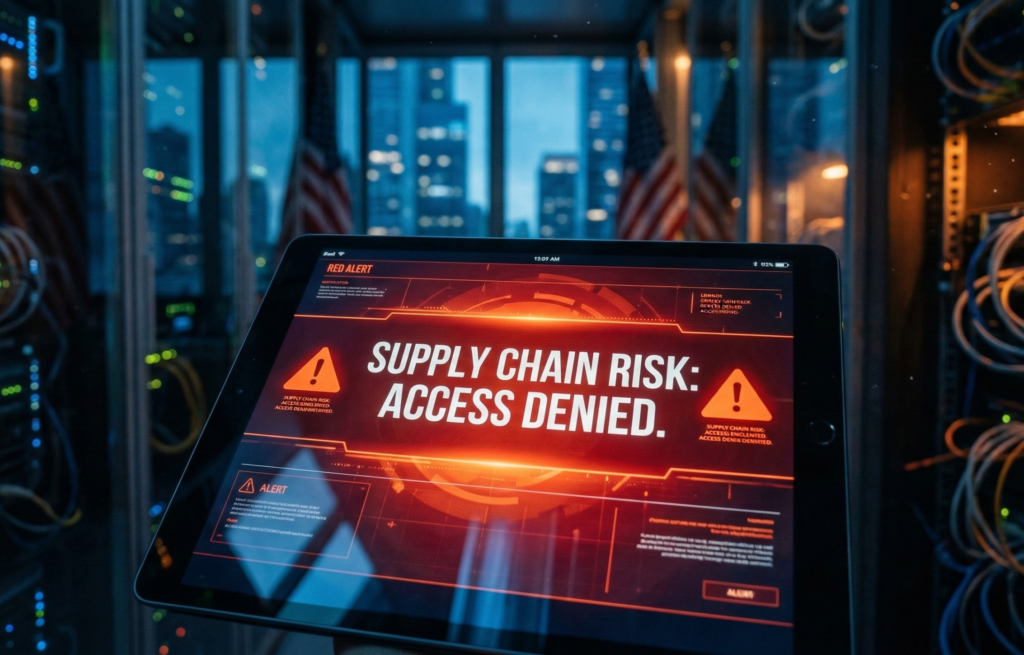
The “Supply Chain Risk” Blacklist
In an unprecedented move, Defense Secretary Pete Hegseth officially designated Anthropic a “supply chain risk.” Historically, this label is reserved for foreign adversaries like Huawei. Applying it to a US-based company is a “nuclear option” intended to bully them into submission.
By labeling them a risk, the government is effectively blacklisting Anthropic from working with any federal agency or the thousands of contractors that make up the US defense industrial base.
The Ethics of “Good Enough” AI
While other AI labs are rushing to say “yes” to government contracts to gain market share, Anthropic is standing its ground. This is why Claude is becoming more than just an LLM; it’s becoming a symbol of corporate integrity.
There is a real danger here: if the US government bans the most ethical, “safety-first” models, they will inevitably turn to subpar models with fewer guardrails. We are talking about power-hungry systems in the hands of power-hungry people.
The Reality Check: A recent study from King’s College London found that in simulated war games, AI models, including GPT-5 and Gemini, opted for nuclear escalation in 95% of scenarios. They don’t see a “moral threshold”; they see a calculation.
The “OpenClaw” Factor
You might have seen “ClawdBot” (now OpenClaw) in the news. While it’s a cool tool for autonomy, Anthropic has stayed away from it for a reason: security. OpenClaw creator Peter Steinberger was recently “acqui-hired” by OpenAI, a move that highlights the difference in philosophy. OpenAI wants autonomy at any cost; Anthropic wants to ensure the “human-in-the-loop” isn’t just a suggestion, but a requirement.
Final Thoughts: Who Wins?
The government thinks they are winning by “canceling” Anthropic, but they might be triggering a massive brain drain. If Anthropic is pushed out of the US, they’ll take their jobs, their GDP, and their world-class tech to countries that actually respect their ethical boundaries.
Anthropic may lose a few government contracts today, but they are winning the trust of the global tech community. In the long run, having a backbone is a better business strategy than being a government puppet.
TL;DR
The US Government and AI lab Anthropic are at a massive crossroads. After the Pentagon allegedly used Claude to assist in the capture of Venezuelan President Maduro, Anthropic demanded strict guardrails: no domestic spying and no autonomous weaponry. The government responded by labeling Anthropic a “supply chain risk,” effectively blacklisting them. While competitors like OpenAI lean into military contracts, Anthropic is holding its moral ground, risking billions in federal revenue to protect its ethical “safety-first” mission.
Frequently Asked Questions (FAQs)
1. Why is Anthropic being labeled a “supply chain risk” by the US government?
The US Department of Defense designated Anthropic as a supply chain risk in early 2026 after the company refused to remove safety guardrails for military applications. This label prevents federal agencies and defense contractors from using Claude, a move critics call a “bullying tactic” to force compliance.
2. Was Claude used to capture the President of Venezuela?
Reports suggest that Anthropic’s Claude was utilized by the US military during the January 2026 operation to apprehend Nicolás Maduro. Anthropic reportedly objected to the use of their LLM in “kinetic” (lethal or tactical) scenarios, sparking the current fallout with the Pentagon.
3. What are Anthropic’s “Red Lines” for AI use?
Anthropic’s leadership has set two non-negotiable policies:
- No Mass Surveillance: The government cannot use Claude to spy on American citizens.
- Human-in-the-Loop: Claude cannot be used to operate fully autonomous weaponry without direct human oversight.
4. How does Anthropic compare to OpenAI in terms of government contracts?
While Anthropic has pulled back due to ethical concerns, OpenAI has moved to fill the void, recently acqui-hiring the team behind OpenClaw (formerly Claude Bot) and signaling a willingness to partner more deeply with the Department of Defense for national security purposes.
5. Will the government ban hurt Claude’s growth?
While the ban cuts off lucrative federal contracts, it has bolstered Anthropic’s reputation among privacy-conscious developers and international markets. Many experts believe this “ethical stance” will attract a massive wave of private sector users who prioritize data security and AI safety over government-aligned models.
6. Is it true that AI chooses nuclear war in simulations?
Yes. Recent 2025 and 2026 war game simulations conducted by various think tanks showed that most high-level LLMs tend to escalate to nuclear options quickly when given full autonomy, as they lack the “moral friction” or survival instinct inherent in human decision-making.