

What is clear is why people think Google is a bigger player than it looks. Google has built its own AI chips, called TPUs (Tensor Processing Units), and it runs them at huge scale in its data centers.
That matters because AI progress is often limited by one thing: how many good chips you can get, and how fast you can use them.
Wait, What About NVIDIA?
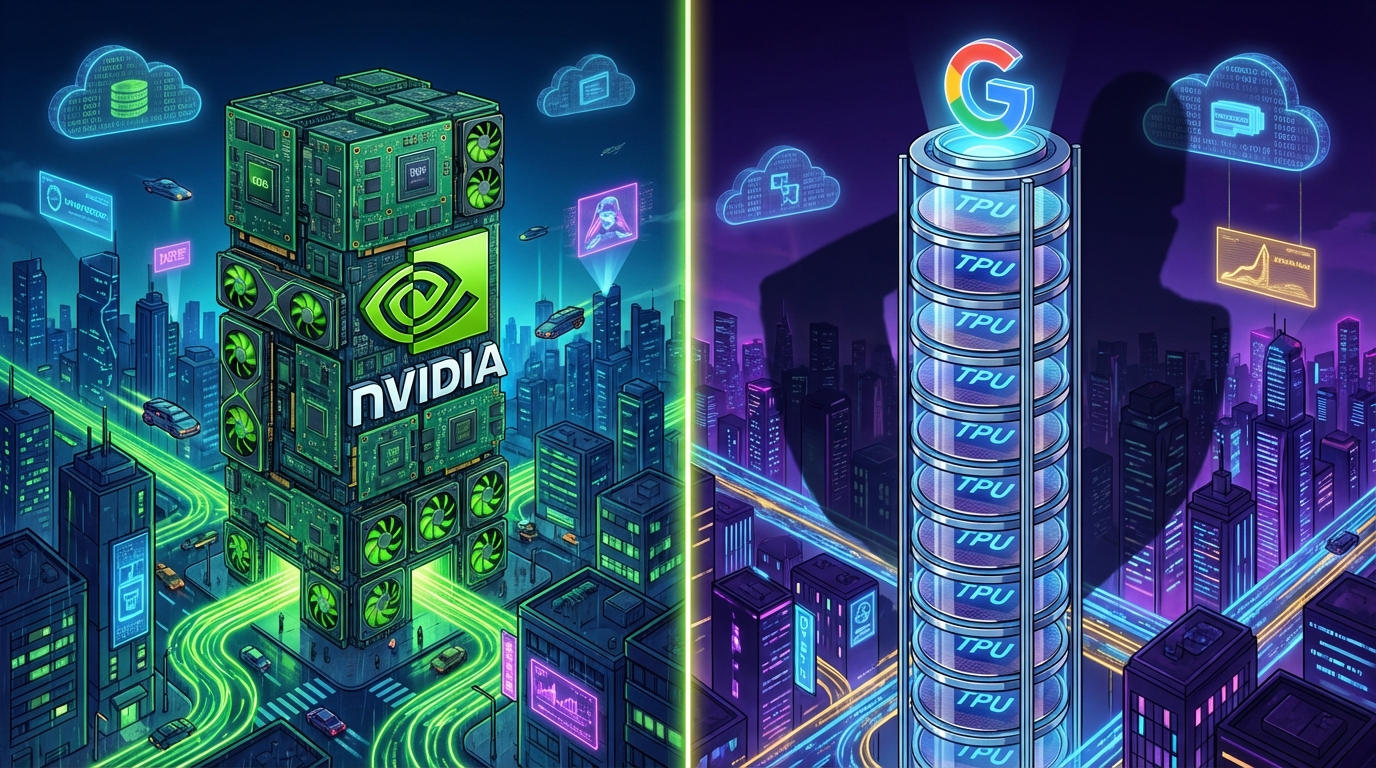
NVIDIA is still the best-known name in AI hardware. Most companies train AI on GPUs (graphics chips that are great at fast math).
Google took a different path. It built TPUs, which are chips made mainly for machine learning (the kind of math AI uses).
Google first revealed its TPU work in 2016, in a post on the Google Cloud Blog. Since then, Google has kept improving TPUs and using them in its own products.
This is the key idea: if you build the chips and the data centers, you can plan your AI roadmap without waiting in line for someone else’s hardware.
What “AI Compute Share” Actually Means
“AI compute” can mean a few different things. People may count:
- Chips shipped (how many units were sold)
- Compute capacity (how much work the chips can do)
- Compute actually used (how much the chips are running)
- Only training, or training + inference (inference means the model answering questions)
Because of that, big numbers like “25% of all AI compute” are usually estimates, not hard facts.
What we can verify is that Google operates TPUs at scale and sells access to them through Google Cloud TPU. That alone makes Google one of the few companies that is not fully dependent on NVIDIA for top-end AI work.
Why Custom Silicon Changes Everything
If you train an AI model, you need lots of compute (raw chip power).
If you have better compute, you can usually do at least one of these:
- Train a model faster
- Train a bigger model
- Serve the model at a lower cost
Building your own chip is not magic. It is also not easy. But it can help with two big problems: price and supply.
If you rely on one outside chip maker, you are stuck with their prices and their delivery dates. If you build your own, you can tune the chip and the whole system around your needs.
Apple made a similar move with Apple Silicon for Macs. Apple explained the shift in its M1 announcement. Google is doing that same kind of “own the stack” move, but for AI data centers.
The Google Cloud Angle You Should Know About
Google does not only use TPUs for itself. You can also rent them through Google Cloud.
This matters for two reasons.
First: it turns Google’s hardware into a product. Instead of only helping Google’s internal teams, TPUs can also bring in cloud revenue.
Second: it is getting easier to use TPUs with popular tools. Many AI builders use PyTorch (a widely used AI coding library). On TPUs, PyTorch support commonly runs through PyTorch/XLA (a system that helps PyTorch run on different chip backends). You can see the project at PyTorch/XLA.
In plain terms: more of your PyTorch code can run on TPUs with fewer changes than in the past. That lowers the “switching cost” for teams that want to try Google’s chips.
What Does This Mean for the AI Landscape?
The AI race is not only about models. It is also about infrastructure (chips, data centers, and power).
Here are a few things to watch:
- Cloud competition is also chip competition. AWS, Azure, and Google Cloud all want to be the place where AI teams build.
- More companies will build their own chips. Amazon offers Trainium. Microsoft has also announced its own AI chips, including Azure Maia.
- Compute concentration is a real issue. When a few companies control a lot of top-tier compute, they can shape prices and access.

What This Means for You
If you are building with AI, this is not just trivia.
If you plan to train models (or run them at scale), it helps to know what hardware options exist. Google’s TPUs on Google Cloud are one of the main alternatives to NVIDIA-based GPU setups.
Also, keep an eye on the “build your own chip” trend. It is becoming a normal move for big tech companies that want to stay competitive in AI.
The hardware layer used to be hidden. Now it is part of the story.
Sources
- Google Cloud Blog, 2016 TPU announcement and early TPU context
- Google Cloud TPU, TPU product overview and availability on Google Cloud
- PyTorch/XLA, PyTorch support path for TPUs and other accelerators
- AWS Trainium, Amazon’s custom AI training chips
- Microsoft Blog, Azure Maia AI chip announcement
- Apple Newsroom, Apple Silicon (M1) strategy reference
TL;DR
- There is no public, audited way to prove any company “owns 25% of all AI compute,” because the definition of “AI compute” varies.
- What is verified: Google has built and run its own AI chips (TPUs) since the TPU work was revealed in 2016.
- TPUs give Google another path besides NVIDIA GPUs, which can help with cost, supply, and long-term planning.
- Google sells TPU access through Google Cloud, so teams can rent TPU power instead of buying hardware.
- The bigger trend: big tech companies are building custom chips (Google TPUs, AWS Trainium, Microsoft Maia), and that is shaping the AI race.
FAQ
Does Google really own 25% of all AI computing power?
There is no public, audited number for “all AI computing power.” Claims like “25%” depend on how compute is counted (chips shipped, capacity, or usage). What we can verify is that Google runs TPUs at large scale and offers them on Google Cloud.
What is a TPU?
A TPU (Tensor Processing Unit) is Google’s custom chip designed for machine learning workloads (the math used in AI). Google uses TPUs in its data centers and also rents them out through Google Cloud.
Are TPUs better than NVIDIA GPUs?
It depends on the job and the software you use. NVIDIA GPUs are widely used across the industry. TPUs can be very strong for certain AI tasks, especially when paired with Google’s cloud setup. Teams often test both to compare speed and cost.
Can I use PyTorch on TPUs?
Yes. A common way is through PyTorch/XLA (a system that helps PyTorch run on TPU backends). That can reduce how much code you need to change compared to older TPU workflows.
Why are Amazon and Microsoft building their own AI chips too?
Custom chips can help big cloud companies control costs, avoid supply limits, and design hardware around their own needs. AWS has Trainium, and Microsoft has announced Azure Maia for AI workloads.